
In India, card games have long since ceased to be merely a form of entertainment for the home. They are a way for a group of people to get together to have fun with family and friends, or to organise a bit of friendly competition during festive occasions. Card games are played in a wide variety of social settings — in the living room, at family gatherings, whilst travelling, and during festivals and celebrations. So the passion for card games here is not just about entertainment, but also has a cultural dimension.
Another factor in their popularity is the versatility of the cards themselves. There is no need for complicated equipment; the rules of many games can be learnt in just a few minutes, and many players can join in simply by switching from one format to another. There are games for relaxed, sociable leisure, as well as those that require counting, memorising information and reacting instantly.
The Indians’ love of card games
In her research, Parminder noted that traditional pastimes such as ‘Teen Patti’ and ‘Rami’ hold a special place. These games have developed their own following, rules and style of play. ‘Thin Patti’ is associated with a festive atmosphere and large crowds, whilst ‘Rami’ is more a matter of systematic thinking about the cards dealt and finding the right combinations.
However, Indian players are not limited to Indian versions alone. With the advent of the internet, people have gained the opportunity to discover international versions of card games, watch global tournaments and learn about new mechanics. Consequently, the traditional gaming culture is gradually being transferred, adapted and transformed into the digital space.
Why the online format is convenient
Digital card games have one obvious advantage: you don’t need to gather a group of people in one room to play. Using a smartphone, you can play at any time that suits you – which works for almost everyone – whilst the interface automatically manages the game, revealing cards and tallying the scores.
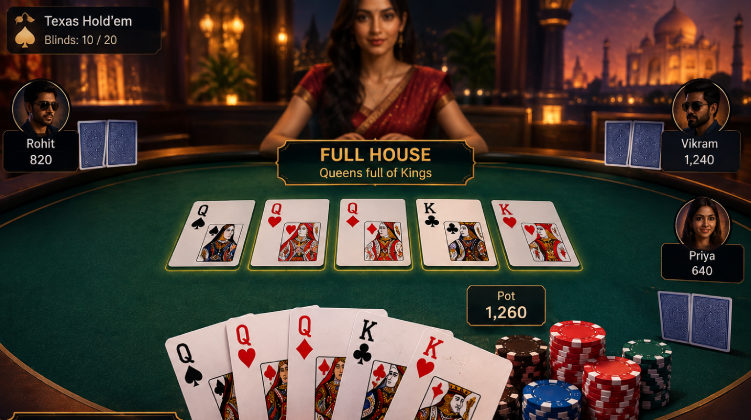
Another important innovation concerns live streams. The live poker format is designed to recreate the atmosphere of a real card table: you can see the dealer, the cards, the chips and everything that’s happening in the studio. For viewers, this option may prove somewhat more engaging than standard animation, as it creates the sensation that you are watching a real-life hand being played.
Why do people particularly enjoy card games?
The popularity of cards can be explained by a combination of several features that are rarely found together in other forms of entertainment.
- Simple rules and scope for skill. Most card games start with a straightforward basis: drawing cards, determining their value and carrying out specific actions. But as players become more familiar with a particular variant, they discover additional nuances relating to probabilities, combinations and tactical choices.
- Furthermore, playing Uvarti can, to some extent, foster a sense of camaraderie amongst the players; apart from the game itself, players can chat and subsequently become friends, and this social aspect is also very appealing to Indians.
- Variety of formats. One person might prefer Rummy, another Teen Patti, and a third classic poker or blackjack. Thanks to this choice, card games do not feel monotonous and can appeal to people with completely different playing styles.
How is the situation different now that online casinos have emerged?
The internet has not destroyed traditional card games; on the contrary, it has made them accessible to a wider audience. Users can now play formats that were previously only available in specialised venues or at international tournaments.
To learn about card combinations, betting procedures and the specifics of each hand, you can take a seat at an online poker table without having to visit a real casino. Live games operate on a similar principle: video cameras record the action from the studio and stream the footage to the user’s device.
In the world of digital gaming, you’ll also find a host of other variations of card games. For a comparison of poker mechanics with the traditional game against the dealer, you can read more in the section https://indian.1xbet.com/en/casino/blackjack. There is a big difference between blackjack and poker: your aim in this game is not to win money from one or more opponents, as in poker, but to reach a certain total and compare it with the dealer’s total.
Playing cards as a reflection of modern India
Today, there are two types of card game enthusiasts. On the one hand, some card games are still played at home and have been passed down from generation to generation; on the other hand, there is the digital realm, where players encounter new rules and international variants.
It is likely that this very combination of tradition and cutting-edge technology is the reason for the enduring appeal of card games. Now, Indian enthusiasts no longer have to choose between familiar old games and new formats: they can enjoy both, whilst noticing the differences in rules, playing styles and ways of interacting with other players.