
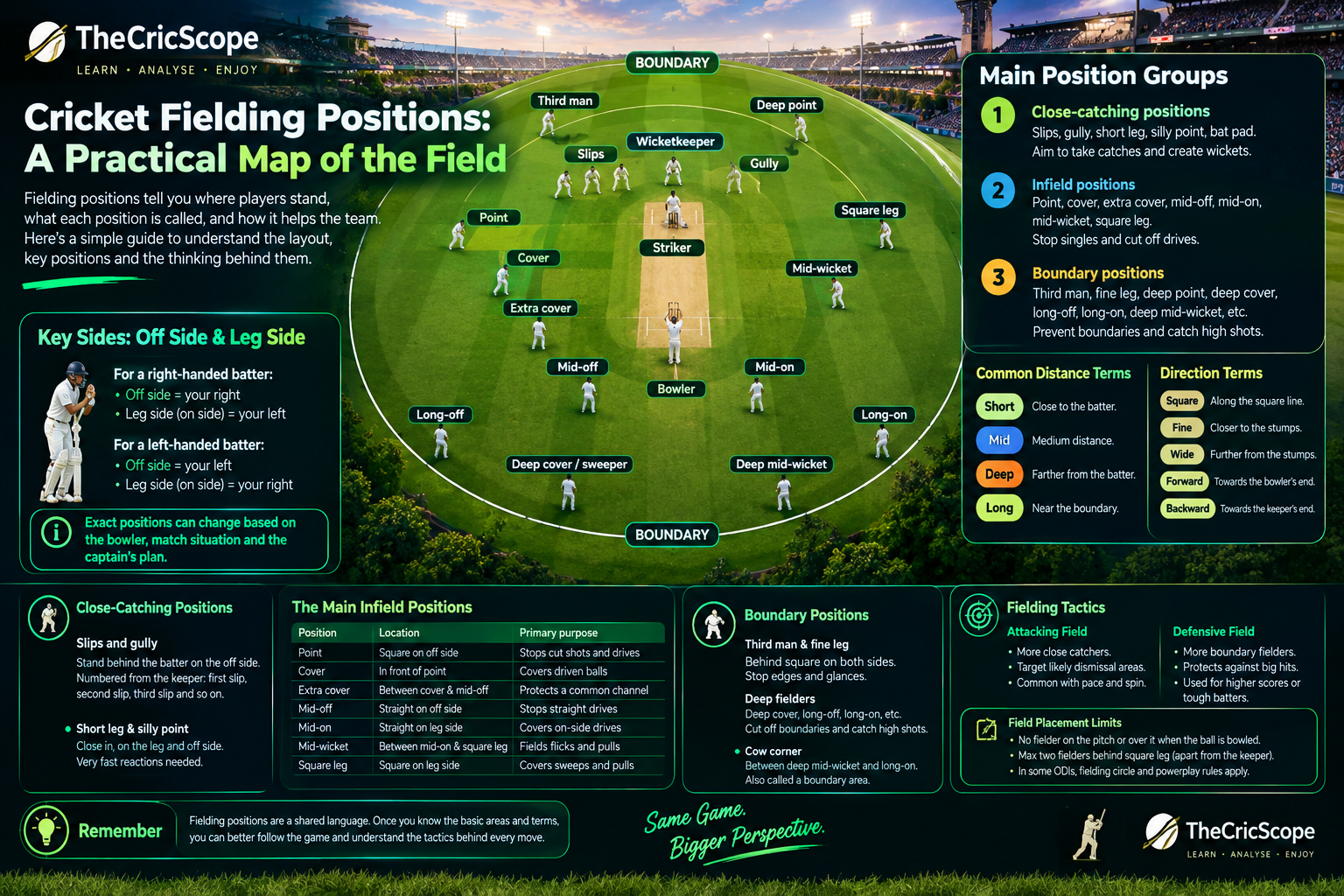
Cricket fielding positions describe where players stand around the batter, with each name indicating an area, angle or distance from the wicket. The most useful way to understand them is to view the field from the striker’s perspective: the off side is to a right-handed batter’s right, while the leg side, also called the on side, is to their left. For a left-handed batter, those sides and the field map reverse.
A simple diagram of cricket fielding positions
This diagram shows the broad location of commonly used positions for a right-handed batter. Exact distances vary according to the bowler, the match situation and the captain’s plan, so a player at cover or fine leg will not always stand in precisely the same spot.
“`text
BOUNDARY
Third man Deep point
Slips Gully
Wicketkeeper
[ Striker ]
Point | Square leg
Cover / extra cover Mid-wicket
Mid-off Mid-on
Long-off Long-on
Deep cover / sweeper Deep mid-wicket
BOUNDARY
“`
The bowler delivers the ball from the opposite end of the pitch, facing the striker. The wicketkeeper stands behind the striker’s stumps, while the remaining fielders are distributed depending on whether the team is trying primarily to take wickets, stop singles or protect the boundary.
How position names work
Most fielding names combine direction with distance. “Mid” generally indicates a medium distance from the batter, while “deep” and “long” mean farther away, often towards the boundary. “Short” means closer to the batter, and “silly” means extremely close, reflecting the danger of being hit by a hard ball with very little reaction time.
Other words explain the angle. “Square” lies roughly along an imaginary line extending from the popping crease. “Fine” is closer to a line running through the pitch and stumps, while “wide” moves farther away from that central line. “Forward” means in front of square, towards the bowler’s end, and “backward” means behind square, towards the wicketkeeper’s end.
There are 11 players in the fielding team, but one is the bowler and another is the wicketkeeper. That leaves nine other players to place around the ground. Captains can move fielders between deliveries and use the available positions to respond to the batter’s strengths, a bowler’s method and the score.
Close-catching positions
Close fielders are placed near the batter to catch an edge, a defensive shot that pops up, or a ball that comes off the pad and bat. These are attacking positions because their main purpose is to create wickets rather than merely prevent runs.
Slips and gully
Slips stand behind the batter on the off side, beside the wicketkeeper. They are numbered outward from the keeper: first slip is closest, followed by second slip, third slip and so on. Together, they are often called the slip cordon. They wait for an outside edge that flies after the ball has passed the bat.
Gully is wider than the slips and normally a little squarer. This position covers edges that travel wider of the cordon. A fly slip is another catching position in a deeper area behind the batter, while leg slip and leg gully perform similar roles on the leg side.
Short leg, silly point and bat pad
Short leg stands very close on the leg side, usually prepared for a ball that takes bat and pad before looping up. It is also known as bat pad. Silly point is close on the off side, in front of square. Both roles demand fast reactions and protective equipment because there is little time to avoid a firmly struck ball.
These positions are common when bowlers are trying to force a mistake from a batter who is defending. Helmets and other protection are often used by close catchers. A short mid-wicket, silly mid-on and silly mid-off are related close positions that may be used for specific bowling plans.
The main infield positions
Infielders cover the areas where batters frequently push or drive the ball for singles. They must be alert for sharp chances, quick ground stops and direct throws at the stumps for run-outs. Their roles may be attacking or defensive depending on how close they stand.
| Position | General location | Primary purpose |
| Point | Square on the off side | Stops cut shots and square drives |
| Cover | In front of point on the off side | Covers driven balls through the off side |
| Extra cover | Between cover and mid-off | Protects a common driving channel |
| Mid-off | Straightish on the off side | Fields straight drives and balls hit back towards the bowler |
| Mid-on | Straightish on the leg side | Covers on-side drives |
| Mid-wicket | Between mid-on and square leg | Fields flicks, pulls and on-side shots |
| Square leg | Square on the leg side | Covers sweeps, pulls and leg-side shots |
Point is one of the most recognisable positions. It stands on the off side near square, ready for shots played with a horizontal bat. Cover is further forward, where a batter may drive the ball through the off side. Extra cover sits between cover and mid-off, giving the captain another option in a busy scoring area.
Mid-off and mid-on stand closer to the line of the pitch, on opposite sides. They often cover straight shots and may also be involved in run-out opportunities. Mid-wicket and square leg protect the leg-side areas where a right-handed batter may work the ball off the pads, pull a shorter delivery or sweep spin.
For regular explanations of match tactics and the language used around field changes, readers can follow TheCricScope alongside watching how captains adjust their formations over an innings.
Boundary positions and saving runs
Outfielders stand farther from the batter, sometimes directly on the boundary. Their job is to cut off fours, catch high shots and return the ball strongly towards the wicket. A captain may send more players deep when a batter is attacking or when the batting side needs quick runs.
Third man is behind square on the off side, often protecting against an edge that runs past the slips or wicketkeeper. Fine leg occupies a comparable area on the leg side and can stop glances, pulls and edges travelling behind square. Short third man and short fine leg are closer versions used to stop a quick single or intercept a less powerful shot.
Deep point and deep backward point cover square shots on the off side. Deep cover, deep extra cover and the sweeper are boundary-oriented placements on the off side. “Sweeper” is an alternative name often used for a deep cover, deep extra cover or deep mid-wicket position intended to prevent a boundary.
Long-off and long-on are deep, straight positions on the off and leg sides respectively. Deep mid-wicket, deep square leg and deep backward square leg offer protection when the batter targets the leg-side boundary. Cow corner is an informal name for a boundary area between deep mid-wicket and long-on.
Attacking and defensive fields
An attacking field puts catchers near likely dismissal areas. For a pace bowler, this may include several slips and a gully, especially when the plan is to draw an edge outside off stump. For spin, an attacking arrangement can include a slip, short leg or silly point, inviting a miscued defensive shot or a bat-pad chance.
A defensive field spreads players across likely scoring zones. Boundary fielders reduce the chance of fours, while players inside the fielding circle look to prevent easy singles. Neither approach is automatically better: the captain weighs the score, remaining time, the batter’s habits, the bowler’s style, the condition of the wicket and the state of the ball.
A field is often described with off-side and leg-side numbers, such as a 5–4 field. The off-side number is stated first, so this means five fielders on the off side and four on the leg side. Teams commonly use more off-side fielders when bowling outside off stump, because that is where many resulting shots and edges travel.
Field-placement limits and practical awareness
Fielders can be placed almost anywhere, but there are restrictions. No fielder may stand on the pitch or have part of their body over it when the ball is bowled. There can also be no more than two fielders, apart from the wicketkeeper, behind square leg at the time of delivery.
In some one-day matches, fielding-circle and powerplay restrictions limit the number of players who can stand outside the marked circle during designated overs. Such rules prevent an overly defensive spread and make placement choices more significant. Players must therefore understand not only position names but also the tactical reason for each move.
Conclusion
Fielding positions are a shared vocabulary for cricket’s tactical map rather than fixed marks on the grass. Once the basic off-side, leg-side, close-in and boundary areas are clear, names such as gully, cover, mid-wicket and fine leg become easier to follow. The field then reveals the contest within every delivery: where the bowling side expects the ball to go, and where the batter hopes it will not.