
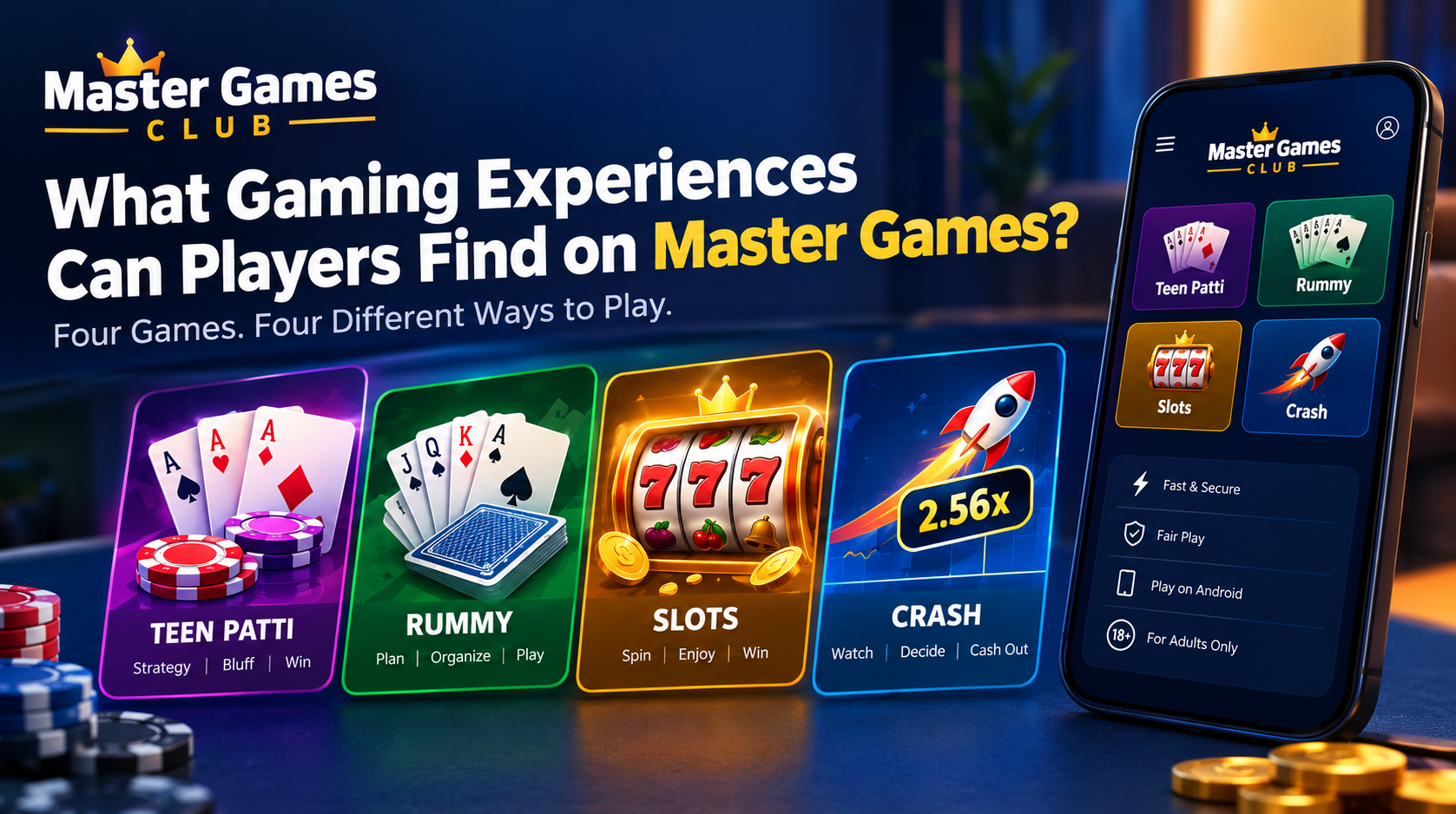
A player who enjoys a careful card game may have little interest in watching a slot reel spin. Someone else might prefer the quick decisions of a crash round to a longer game of rummy. Treating these players as one audience misses something important: online gaming platforms can bring together very different kinds of entertainment, each with its own pace, rules and demands on the person playing.
That variety is central to the experience available through Master Games Club. Its Android app brings four distinct formats into one lobby: Teen Patti, Rummy, Slots and Crash. The interesting part is not simply that there are four choices. It is how differently each game asks players to think, wait, decide and respond.
Four Games, Four Different Ways to Play
The clearest way to understand the selection is to look at what a player actually does in each format.
Teen Patti is built around three-card hands, betting decisions and the possibility of bluffing. Players must judge their own cards while considering what others might be holding. A round can move quickly, but the decisions are not always straightforward. The appeal often lies in reading the situation rather than simply waiting for the next card.
Rummy requires a different kind of attention. In the 13-card Indian version, players work towards valid sequences and sets, making decisions about which cards to keep and which to discard. A player needs to remember what has appeared, recognise useful combinations and adjust when the hand does not develop as expected. It is a more sustained exercise in organising information.
Slots offer a simpler interaction. Players choose a game, review its paytable and decide whether to spin. There is little of the hand-by-hand judgement found in card games; the outcome is determined by chance. The visual presentation, reel format and pace are the main parts of the experience.
Crash games introduce another kind of tension. A multiplier rises during a round, and the player must decide whether to cash out before the round ends. The interface may look simple, but the decision involves uncertainty and timing. No strategy can guarantee a favourable result.
These differences matter because a platform’s game count says very little about whether its selection suits a particular person.
The Choice Is Really About Pace and Attention
A useful way to compare game formats is to consider how much attention a session requires.
Someone with ten uninterrupted minutes might enjoy a Rummy table, where following the cards and planning combinations is part of the attraction. A person looking for a shorter interaction may prefer a quick Teen Patti hand or a brief Crash round. Slots involve a different rhythm: the player makes a selection, starts a spin and sees the result.
This does not mean one format is better than another. The experience changes with the amount of time, concentration and decision-making involved.
A useful gaming lobby should make those differences easy to recognise. Clear game names and short descriptions help, but the rules matter just as much. A new player should be able to understand whether a game involves other participants, random outcomes, card combinations or a timing decision before entering it.
Familiar Rules Do Not Remove the Need for Clear Information
Recognising a game is not the same as understanding how a particular online version works.
A person who has played Teen Patti with friends may already know the basic idea, but online tables can have different stakes, betting limits and variations. Rummy players face a similar issue: the broad objective may be familiar, while the available table formats and scoring details still need attention.
This is where a platform’s presentation becomes part of the gaming experience. Rules should be accessible before a player joins a table, not hidden behind several screens. Costs, limits and any applicable fees should be visible before a decision is made.
The game descriptions and instructions available through master games give players a place to examine the different formats before choosing one. That kind of information is more useful than a promotional description that simply calls every game exciting.
There is also a practical distinction between free practice and real-money play. Practice tables can help someone learn the interface and understand a game’s sequence without immediately committing money. They should not, however, be mistaken for evidence that real-money outcomes will be predictable.
One App Does Not Mean One Shared Experience
Putting several games in a single app can make switching between formats easier. A player does not need to search for a separate service every time their preference changes. Yet a shared lobby should not make every game feel identical.
Teen Patti needs a table layout that makes cards, betting options and other players’ actions easy to follow. Rummy benefits from a clear view of the hand, discarded cards and possible combinations. Slots depend more on readable paytables and straightforward controls. Crash needs the multiplier and cash-out action to remain clear throughout a round.
These are different design problems. A layout that works well for a slot game may be unsuitable for a card table, where players need to compare several pieces of information at once.
The master games lobby places all four formats in one app, but each still needs controls suited to its own mechanics.
The same principle applies to mobile use. Small screens leave less room for instructions and controls, so important information should not be buried in menus or displayed in text that is difficult to read. Good design is not about adding more animation. It is about helping players understand what is happening without unnecessary effort.
What Players Should Check Before Joining
The variety of games is only one part of choosing an online platform. Players should also look at the conditions surrounding each format.
For card games, check the table rules, entry amount, limits and fees. For slots, read the paytable and understand that each spin is an independent game of chance. For Crash, remember that a rising multiplier does not make the next outcome predictable. Previous rounds cannot guarantee what will happen in the next one.
It is equally important to check whether a game is legally available in the player’s state. Age restrictions and identity-verification requirements should be taken seriously. Master Games Club states that its app is intended for adults aged 18 and over and that game availability is checked according to the player’s state during registration. Players should still make sure they understand the rules that apply where they live.
Players should also set personal spending and session limits before starting. Real-money games involve financial risk and can become habit-forming. Taking a break or choosing not to play is always a valid decision.
Variety Is Valuable When Players Can Make Informed Choices
The strongest feature of a multi-game platform is not necessarily the number of titles it lists. It is whether players can understand the differences between them and choose according to their own preferences.
Master Games Club brings together card games that involve decisions against other players, a slot format based on chance and a crash format built around timing. Each creates a different kind of session. The selection is best understood as a collection of distinct experiences rather than four versions of the same activity.
For players, that distinction is worth considering before they open a game. A good choice starts with knowing what the game asks of you, what its rules allow and what risks come with participation. The more clearly a platform communicates those details, the easier it is for adults to decide whether a particular experience is right for them.